

AC Installation & Replacement Services in Central Florida
When it is time for a new air conditioner, the installation should be handled by experienced, licensed professionals. A cooling system is only as good as the work that puts it in, and a unit that is sized wrong or connected poorly will never deliver the comfort or efficiency it was built for.
True Plumbers & AC installs new air conditioning units for residential and commercial properties in Lakeland, Plant City, and Winter Haven. Our licensed HVAC technicians handle the entire job, from selecting the right equipment to the final thermostat, and we back our work with a 4.8-star reputation across more than 2,100 reviews.
Key Takeaways
The short version, if you are pricing a new system this week.
- What it costs: Angi puts HVAC replacement in the Tampa, Florida metro at $7,568 on average, with most homeowners between $5,045 and $12,613. Those are market figures, not our prices.
- Efficiency floor: Florida sits in the US Department of Energy Southeast region, where split system air conditioners under 45,000 BTU per hour must meet 14.3 SEER2.
- Sizing is not square footage alone: A proper load calculation weighs insulation, window area and orientation, ceiling height and duct condition. Oversizing is the most common and most expensive mistake here.
- Federal tax credit: The Section 25C home improvement credit ended for property placed in service after December 31, 2025, so it does not apply to a 2026 installation.
- Utility rebates do apply: Lakeland Electric and Duke Energy Florida both run residential HVAC rebate programs.
- Permits are required: Florida Building Code Section 105.1 requires a permit to replace a mechanical system. We pull it.
- Electrical work: If your new system needs a panel or circuit upgrade, we coordinate a licensed electrical contractor. True Plumbers & AC does not perform electrical work.
AC Installation in Lakeland and Plant City
True Plumbers & AC installs and replaces residential air conditioning systems across Polk County and eastern Hillsborough County, centered on AC installation in Lakeland, Plant City and Winter Haven. Our trucks work this corridor daily, which is why a replacement quote here does not take a week to schedule.
Replacement timing works differently in Central Florida than the national averages suggest. A system that would see fifteen years of service in a temperate climate often reaches the end of its economic life here closer to ten or twelve, because it runs most of the calendar and spends much of that runtime doing dehumidification rather than simple cooling. That is normal wear for this operating environment rather than a sign of a bad unit.
It also changes what the right system looks like. Latent capacity, meaning the system ability to remove moisture, matters at least as much as raw cooling tonnage in a house that fights humidity nine months a year. A variable speed or two stage system holds longer, gentler cycles that wring more water out of the air, which shows up as a house that feels dry at 76 degrees instead of cold and clammy at 72.
We have been installing systems in this area since 2009 under Florida HVAC license CRC1335717, and we carry a 4.8 star rating across more than 2,100 reviews. If you want the background on the company, our about page covers it.
What a New AC System Costs in Central Florida
Replacing an HVAC system averages $7,568 in the Tampa, Florida market, and most homeowners land between $5,045 and $12,613. Angi publishes these figures for Tampa. Three rows below fall back to national ranges, where no local figure exists.
Use them to judge whether an estimate you have received is in a sane range. Your actual price comes from a technician who has measured your home, and you get it in writing before anything is ordered.
| System or work | Market range | Source |
|---|---|---|
| Typical HVAC replacement | $7,568 on average, with most homeowners between $5,045 and $12,613 installed | Angi, Tampa FL cost data |
| Top of the range, larger or high efficiency systems | Up to $22,198 installed | Angi, Tampa FL cost data |
| Permits and add-on work | Adds $250 to $3,100 or more on top of the system | Angi, Tampa FL cost data |
| Full duct replacement | $3,000 to $8,000 | Angi, Tampa FL cost data |
| Partial duct repair | $1,500 to $4,000 | Angi, Tampa FL cost data |
| Three ton system | $4,451 to $8,099 installed | Fixr, national range |
| Five ton system | $7,000 to $12,000 installed, averaging $10,000 | Fixr, national range |
| Air handler replacement on its own | $1,800 to $3,500, averaging $2,800 | Angi, national range |
Sources: Angi HVAC replacement cost data published for Tampa, Florida, plus national ranges from Fixr and Angi where no Tampa figure exists. To be explicit: these are third-party market ranges, not quotes from True Plumbers & AC.
Get a Written Quote Before Anything Is Ordered
Nobody should buy a system off a price range on a web page. We come out, measure the house, run the load calculation, look at your existing ductwork and electrical service, and then put a fixed number in writing along with the equipment model and what the installation includes. You compare that against other bids at your own pace.
If the number is larger than you planned for, say so. Financing is available and approval takes minutes, and it is a normal way to handle an unplanned system failure rather than a last resort. Call (863) 667-6364 or book an estimate through our online scheduler.
SEER2 Ratings and What Florida Requires
Florida falls inside the US Department of Energy Southeast region, where split system central air conditioners under 45,000 BTU per hour must meet a minimum of 14.3 SEER2, and systems of 45,000 BTU per hour and above must meet 13.8 SEER2. The standard is set federally at 10 CFR 430.32 rather than by a Florida-specific code, and it is published by the Department of Energy in the Electronic Code of Federal Regulations.
The Southeast rule restricts installation as well as manufacturing. A non-compliant outdoor unit combination may not legally be installed in this region even if the equipment itself was built before the standard took effect. That is what stops discount out-of-region equipment from turning up in Florida driveways.
SEER2 replaced the older SEER metric and is measured under higher external static pressure, which better reflects real ducted systems. The practical consequence is that a SEER2 number reads slightly lower than the SEER number for the same equipment, so a 14.3 SEER2 unit is not a downgrade from a 15 SEER unit you were quoted years ago. Our glossary of air conditioning terms unpacks the rest of the acronyms.
Whether to go above the minimum is arithmetic. Higher SEER2 costs more up front and returns it through lower bills, and because Florida systems run so many hours a year, the payback period here is shorter than national averages imply. We will show you that comparison for your actual home rather than pushing the top of the catalog.
Sizing: What a Load Calculation Actually Considers
The right system size comes from a load calculation, not a square footage chart. You will see rules of thumb online suggesting one ton of cooling per 400 or 600 square feet, and we are deliberately not publishing one, because in Central Florida those shortcuts produce oversized systems that cool the air quickly, shut off before they have removed the humidity, and leave a house that reads 74 degrees and feels clammy.
A proper calculation weighs the following. Two houses of identical square footage on the same street can land a full ton apart once these are accounted for.
- Conditioned square footage and ceiling height: Volume of air, not floor area, is what the system has to move and treat.
- Insulation levels: Attic, wall and floor R values, which vary enormously between a 1970s Lakeland block home and new construction.
- Window area, glazing and orientation: West facing glass in Florida is a heat load all its own, and single pane windows change the answer substantially.
- Duct condition and location: Leaky ducts running through a 130 degree attic waste capacity before the air reaches a room.
- Air infiltration: How tight the building envelope is, measured or estimated rather than assumed.
- Occupancy and internal gains: People, appliances and lighting all add heat the system has to remove.
- Humidity load: The one that Florida sizing lives or dies on, and the reason latent capacity gets weighed separately from sensible cooling.
What Installation Day Looks Like
A straightforward changeout is usually a single day. Here is the sequence, so nothing on the schedule surprises you.
- Permit is pulled: Florida Building Code Section 105.1 requires a permit to replace a mechanical system, and we file it before the crew is scheduled. Do not hire a contractor who offers to skip it, because the unpermitted work becomes your problem at resale or on an insurance claim.
- Crew arrives and protects the space: Floor coverings go down along the path from the door to the air handler, and the work area gets contained.
- Refrigerant is recovered: The old charge is recovered into EPA compliant equipment rather than vented, which is both the law and the reason this step is not optional.
- Old equipment is removed: Outdoor condenser and indoor air handler come out, along with the old line set connections and any ductwork that will not be reused.
- Pad, platform and connections are prepared: The condenser pad is leveled or replaced, the air handler platform is checked, and the condensate drain is rerun with a proper trap and cleanout.
- New equipment is set and connected: Condenser and air handler are placed, the line set is brazed under a nitrogen purge to keep the interior clean, and the electrical whip and low voltage controls are landed.
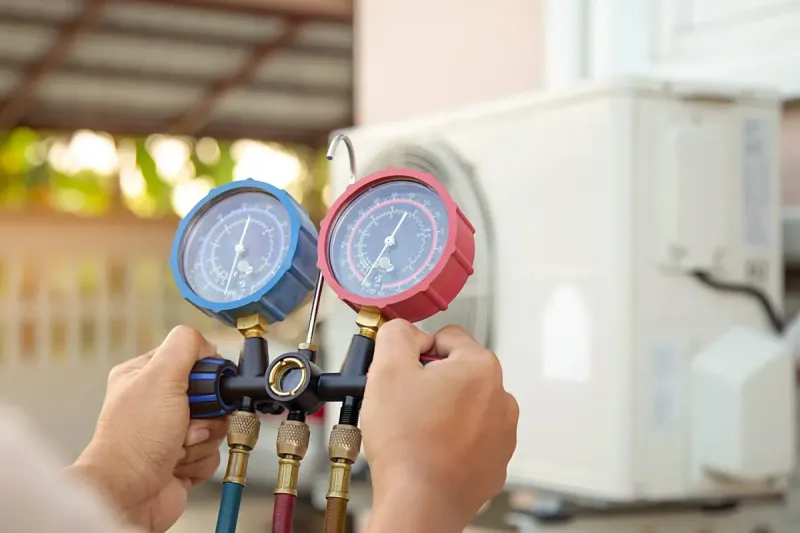
- System is evacuated and charged: A deep vacuum pulls moisture and non-condensables out of the lines before the refrigerant charge is weighed in to the manufacturer specification.
- Thermostat is installed and configured: The new thermostat is wired, staged correctly for your equipment, and connected to Wi-Fi if it is a smart model.
- Startup and commissioning: Superheat and subcooling are measured, airflow is verified, and the temperature split across the coil is checked against target rather than assumed.
- Walkthrough and inspection: We show you the filter location, the drain cleanout and the breaker, register the equipment warranty, and meet the county inspector when the permit is closed out.
Rebates and Tax Credits in Florida
The federal picture changed recently and you should have it straight before budgeting. The Section 25C Energy Efficient Home Improvement Credit, which many homeowners used to offset a high efficiency system, was terminated by Public Law 119-21 and, per the IRS, is not allowed for property placed in service after December 31, 2025. It does not apply to a 2026 installation. Any contractor still advertising it is working from stale material.
Florida has no active statewide HVAC rebate program. The federally funded Home Electrification and Appliance Rebates program administered by the Florida Department of Agriculture and Consumer Services has not launched and is not accepting applications, so we do not build it into anyone budget.
Utility rebates are the real opportunity, and they depend on who bills you for electricity. Confirm current terms with your utility directly, since amounts and efficiency thresholds change.
- Lakeland Electric: Offers a $450 Energy Efficient Heat Pump Rebate for a qualifying replacement at a minimum of 15.2 SEER2, $225 per outdoor condensing unit for mini splits up to two units, and a separate HVAC annual maintenance rebate of up to $100, per the Lakeland Electric programs and services page.
- Duke Energy Florida: Its Home Energy Improvement program offers up to $1,000 toward HVAC replacement for single family homes, with a free Home Energy Check as a prerequisite, per Duke Energy. Confirm the current amount with Duke before relying on it.
- Tampa Electric: Its Heating and Cooling program offers $40 at a minimum of 15.20 SEER2 and $550 at a minimum of 16.20 SEER2, submitted by the contractor within 90 days, per Tampa Electric. This applies to Hillsborough County addresses, not Polk.
- Manufacturer promotions: Equipment rebates come and go seasonally and are usually the largest single discount available. We will tell you what is running when you get your quote rather than making you find it.
Financing a New AC System
Air conditioners rarely fail on a convenient month, and a full system replacement is a real number for most households. We offer HVAC financing so a failed compressor in August does not become a choice between a working house and an emptied savings account. Applications take a few minutes and you will know where you stand before the crew is scheduled.
Financing also changes which system makes sense. When the whole cost lands at once, most people buy the cheapest unit that will cool the house. Spread across monthly payments, the gap between a minimum efficiency system and a higher SEER2 one is often small enough that the utility savings cover much of the difference, particularly given how many hours a Florida system runs. We will run that comparison honestly, including the case where the entry level system is the right call.
Electrical Work and Permits
Replacing an air conditioner sometimes surfaces electrical work, most often when an older panel cannot support a modern system, when the disconnect or whip is undersized, or when a heat pump adds auxiliary heat strips the existing circuit was never sized for. Be clear on how we handle that: True Plumbers & AC provides plumbing, HVAC and water systems services, and we do not perform electrical work. When your installation needs it, we identify the requirement during the estimate, not on installation day, and we coordinate a licensed electrical contractor so the two trades are scheduled in the right order.
Permitting we handle ourselves. Florida Building Code Section 105.1 requires a permit to replace a mechanical system, and the county inspection that follows is what confirms the work meets code. We pull the permit, schedule the inspection and close it out, and the paperwork stays with your property record where it belongs when you eventually sell the house.
Protect the Investment With Maintenance
A new system is the largest home comfort purchase most people make, and the fastest way to lose value on it is to install it and forget it. Manufacturer warranties generally require documented annual service, so skipping maintenance can quietly void the coverage you paid for at exactly the moment you need it.
Annual AC maintenance keeps the condensate drain clear, the coils clean and the refrigerant charge verified, which is the difference between a system that reaches its rated life and one that limps to year eight. Our True Home Membership bundles scheduled inspections with priority scheduling, no dispatch fees and a discount on repairs, and it covers plumbing alongside HVAC.
Two other upgrades are worth considering while the system is open. A whole home dehumidifier handles the mild rainy days when the air conditioner barely runs and indoor humidity creeps up regardless of the thermostat setting. Indoor air quality equipment is far cheaper to integrate during an installation than to retrofit later, and our notes on improving indoor air quality cover which upgrades change the air you breathe and which mostly change your bill.
If you are still deciding whether to replace at all, the warning signs it is time to replace your AC unit are a useful gut check, and AC repair remains the better answer for a newer system with a single failed part.
Repairing or Replacing Your AC Unit
Because air conditioners run year-round in Central Florida, units age quickly. When a system older than 10 years starts facing expensive repairs, replacement often makes more sense than pouring money into aging equipment.
Our technicians advise you on the timing, explain where your current unit stands, and complete the installation when you decide to move forward. The choice stays yours, with honest guidance behind it.
Selecting the Right AC Unit
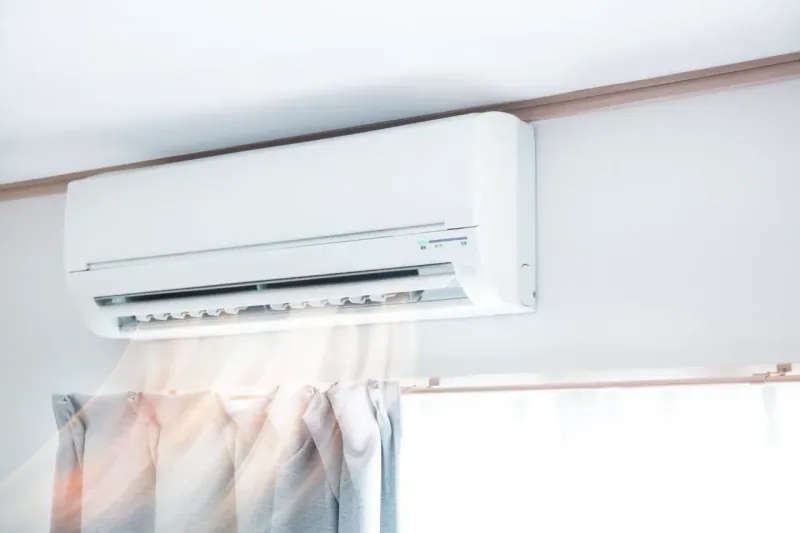
Proper sizing is critical. We base the recommendation on your property square footage and your actual cooling requirements, because a unit that is too small will never keep up and one that is too large will short-cycle and struggle with humidity.
We carry all major brands, including American Standard, Carrier, Coleman, Honeywell, Lennox, Rheem, Trane, and Whirlpool, so we can match the equipment to your home and budget rather than forcing a single product on every customer.
A conventional split system is not always the right answer either. Heat pumps handle both heating and cooling from one piece of equipment and suit our mild winters well, and ductless mini splits are often the better solution for a converted garage, a Florida room or an addition that the existing ductwork was never designed to reach.
Our Installation Process
Every installation starts with an assessment of your current system to determine the right repair-versus-replacement path. From there, the work involves removing the old unit, making any needed changes to the concrete pad or rooftop supports, and renewing the refrigerant line set and condensate drain piping. Where the job also requires electrical changes, we identify them during the estimate and coordinate a licensed electrical contractor rather than performing that work ourselves.
- Obtain any permits needed for installation
- Install the new thermostat
- Remove the old unit and any unneeded existing ductwork
Why Work With True Plumbers & AC?
A complete installation is far more than connecting a new unit to the existing setup. Our licensed HVAC technicians are equipped to handle the unexpected issues that surface mid-job and to assess the refrigerant lines, drain piping, and electrical components that a new system depends on.
We also have the capability to install systems from scratch, including building out the concrete pad or rooftop supports, which means a new build or a major change does not send you looking for a second contractor.
Ready for a New Air Conditioner? Contact Us Today
We are known throughout Central Florida for our service and our expertise. Whether you are dealing with a unit that has reached the end of the road or you are planning a new installation, our team is ready to help you choose and install the right system.
Reach out for a quote and we will walk you through your options.