
Tankless Water Heaters Services in Central Florida
A tankless water heater heats water only when you open a tap, which means no storage tank, no standby energy loss, and no running out mid-shower. True Plumbers & AC installs, services, and descales gas and electric tankless systems across Lakeland, Plant City, and the surrounding Central Florida communities under Florida plumbing license CFC1428965.
Tankless is a genuinely good fit for some homes and a genuinely bad fit for others, and this page is written to help you tell which one you have. That includes the honest answer to the question homeowners keep asking us, which is why so many plumbers push back on tankless in the first place.
Key Takeaways on Tankless Water Heaters in Central Florida
Tankless is a good buy for the right house and a poor one for the wrong house. These six points are how you tell which you have.
- Efficiency is real but modest: the U.S. Department of Energy reports demand water heaters are 24% to 34% more energy efficient than storage tanks in homes using 41 gallons of hot water or less per day.
- The upfront cost is the hurdle: national guides put installed tankless systems at roughly $1,400 to $5,600 versus roughly $882 to $1,814 for a standard tank (HomeGuide, 2026).
- Payback is slow: on the energy savings alone, the higher install cost takes many years to recover, so buy tankless for the endless hot water and the space, not as an investment.
- Hard water is the enemy: Central Florida groundwater scales a heat exchanger, and a tankless unit here needs descaling to reach its full life.
- A permit is required: Florida Building Code treats a tankless installation as permitted plumbing work.
- It is rarely a straight swap: most tank-to-tankless conversions need a larger gas line, added venting, or dedicated circuits.
Tankless Water Heater Installation in Lakeland and Plant City
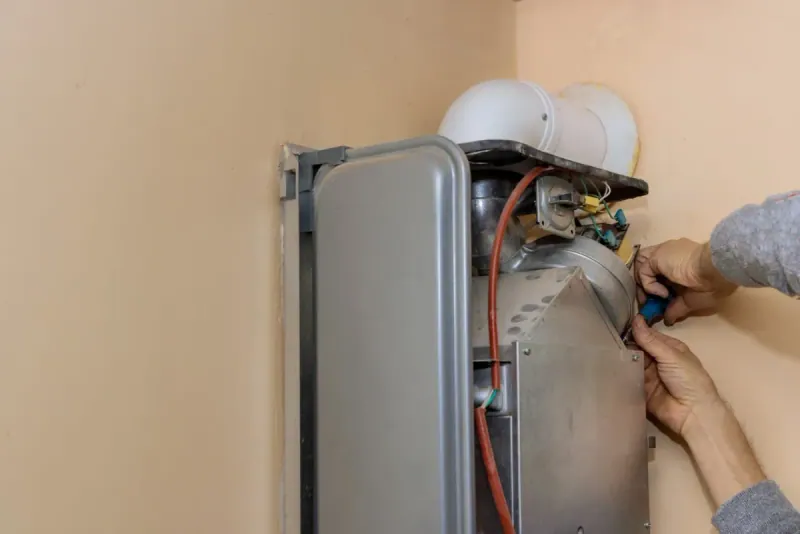
Installing a tankless water heater in a Central Florida home starts with an evaluation of what the house can already supply, because the unit is only as good as the gas line or the electrical service feeding it. That evaluation is the single biggest difference between a tankless install that delivers what the brochure promised and one that disappoints on day one.
In Lakeland, a large share of the homes we work in are on electric service with no gas at the street, which points toward an electric tankless unit or a whole-home electrical conversation before anything else. In Plant City and the more rural stretches around it, propane is common, and a propane tankless unit often needs a larger supply line and a regulator sized for the burner. Neither of those is a problem, but both change the quote, which is why we look before we price.
We install tankless systems across Winter Haven, Wesley Chapel, Zephyrhills, and the surrounding Polk County, eastern Hillsborough County, and southeastern Pasco County areas as well.
- Evaluate the supply: gas line diameter and length, or electrical panel capacity and available circuits.
- Confirm the location: tankless units are wall-mounted and about the size of a travel suitcase, so the old tank footprint often frees up entirely.
- Plan the venting: gas units need dedicated, correctly sloped venting to the exterior.
- Plan for service: a good install leaves isolation valves in place so the unit can be descaled without cutting pipe.
How a Tankless Water Heater Works
A tankless water heater passes cold water across a heat exchanger that fires the instant a hot tap opens, and shuts off the instant it closes. There is no reservoir sitting at temperature, so there is nothing to lose heat overnight and nothing to corrode from the inside out the way a storage tank eventually does.
The trade-off built into that design is flow rate. A tank holds a fixed volume ready to go, while a tankless unit is limited by how much water it can raise to temperature per minute. That limit is what makes correct sizing non-negotiable and what causes the classic complaint of lukewarm water when the shower and the dishwasher run together.
Tank vs Tankless: The Comparison That Decides It
Choose tankless if you value endless hot water and floor space and can absorb a higher install cost. Choose a tank if the priority is the lowest upfront number and the simplest replacement. The rows below are the factors that actually settle the decision.
If you would rather read a longer side by side, our blog post on tankless water heaters versus tank water heaters covers the same ground, and the water heater replacement page has the sizing guidance for storage tanks.
| Factor | Tank | Tankless | Advantage |
|---|---|---|---|
| Upfront cost | Roughly $882 to $1,814 installed | Roughly $1,400 to $5,600 installed | Tank |
| Payback period | No extra install cost to earn back | The energy savings are real but modest, so the extra install cost typically takes many years to recover and often does not fully pay back within the life of the unit | Tank |
| Lifespan | Generally eight to twelve years in Central Florida | Commonly expected to run fifteen to twenty when well maintained | Tankless |
| Space | Occupies floor space in a garage or closet | Hangs on the wall at roughly the size of a travel suitcase | Tankless |
| Recovery and capacity | Delivers a large volume fast and then needs to reheat | Never runs out but is capped at a fixed flow rate per minute | Depends on your household |
| Risk of water damage | Holds forty to fifty gallons that can end up on your floor | Holds almost none | Tankless |
Upfront cost figures: HomeGuide, 2026. Those are third-party market ranges, not True Plumbers & AC pricing.
Tankless Water Heater Cost in Central Florida: Third-Party Market Ranges
The reason a tankless quote varies so much more than a tank quote is the work around the unit rather than the unit itself. A house with the right gas line and venting already in place lands at the bottom of these ranges. A house that needs a supply upgrade lands considerably higher.
| Unit or work | Market range | Source |
|---|---|---|
| Tankless system, installed, all fuel types | Roughly $1,400 to $5,600 | HomeGuide, 2026 tankless water heater cost guide |
| Gas tankless, unit and labor and required modifications | Roughly $2,100 to $5,600 | HomeGuide, 2026 |
| Electric tankless, installed | Roughly $1,400 to $3,000, generally cheaper and simpler than a gas install | HomeGuide, 2026 |
| Labor alone | Roughly $600 to $2,500, covering three to ten hours depending on difficulty and the upgrades involved | HomeGuide, 2026 tankless water heater cost guide |
| Larger diameter gas supply line | Roughly $350 to $2,000, or up to $2,000 to bring gas to a home that never had it | HomeGuide, 2026 gas line installation cost guide |
| Electrical work for an electric unit | A dedicated circuit runs roughly $250 to $900 and a full panel replacement roughly $850 to $1,700. True Plumbers & AC does not perform electrical work, so a licensed electrician handles this part | HomeGuide, 2026 |
Source: HomeGuide, 2026. These are general third-party market ranges published for the United States. They are not True Plumbers & AC pricing and they are not a quote for your home.
Getting a Real Tankless Quote From True Plumbers & AC
We price your job after we have seen your gas line, your panel, your venting path, and the wall the unit is going on, and you get that price in writing before we start. National averages cannot tell you whether your supply line is undersized, and that one detail moves a tankless quote more than any other.
Financing on approved credit is available if the upfront cost is the sticking point. Call (863) 667-6364 or schedule a visit online and we will give you a number you can actually plan around.
Why Are Plumbers Against Tankless Water Heaters?
Most plumbers install tankless water heaters happily. What they push back on is tankless installed in the wrong house, and there are four fair reasons behind that caution.
The first reason is that the payback rarely works on paper. A tankless unit costs meaningfully more to install, and the Department of Energy's 24% to 34% efficiency advantage applies to homes with relatively low hot water use. Run the arithmetic on a typical Florida utility bill and the savings take a long time to cover the difference. A plumber who tells you the unit pays for itself quickly is selling, not advising. Buy tankless because you want endless hot water and your garage back, and treat the efficiency as a bonus.
The second reason is that a bad install ruins the experience. Undersize the unit or the gas line and the homeowner gets lukewarm water whenever two fixtures run at once, then blames the technology instead of the sizing. Plumbers who have been called out to fix somebody else's tankless conversion get cautious for good reason.
The third reason is maintenance, and in Central Florida it is the big one. A tankless unit needs periodic descaling to keep the heat exchanger clear. Skip it for years and the unit underperforms and fails early, and the homeowner concludes tankless was a mistake when the real problem was untreated hard water. A storage tank hides that neglect for years, because sediment has somewhere to sit. A tankless unit shows it within a season or two.
The fourth is the cold water sandwich, which is the brief slug of cool water you feel when a tap is turned off and back on quickly. Modern units with a small buffer tank have largely solved it, but it is real on older and cheaper models and worth knowing about before you buy.
- Tankless is a good fit when: you want unlimited hot water, you need the floor space, the house has adequate gas or electrical supply, and you will keep up with descaling.
- Tankless is a poor fit when: the budget is tight, the house needs major supply upgrades, or nobody is going to maintain it.
Hard Water, Descaling, and Tankless Maintenance in Lakeland
A tankless water heater in Central Florida needs to be descaled, and that is the maintenance step homeowners most often skip. Our water comes from the Floridan Aquifer, where it picks up dissolved calcium from limestone on the way to the well, and that calcium precipitates onto the hot surfaces of a heat exchanger as scale.
Scale in a heat exchanger is not like sediment in a tank. There is no spare volume for it to settle into, so it restricts flow and insulates the very surface the unit relies on, and the symptoms show up as reduced flow, temperature swings, and eventually an error code. Descaling flushes it out with a circulated solution through the isolation valves, which is why we insist on installing those valves in the first place.
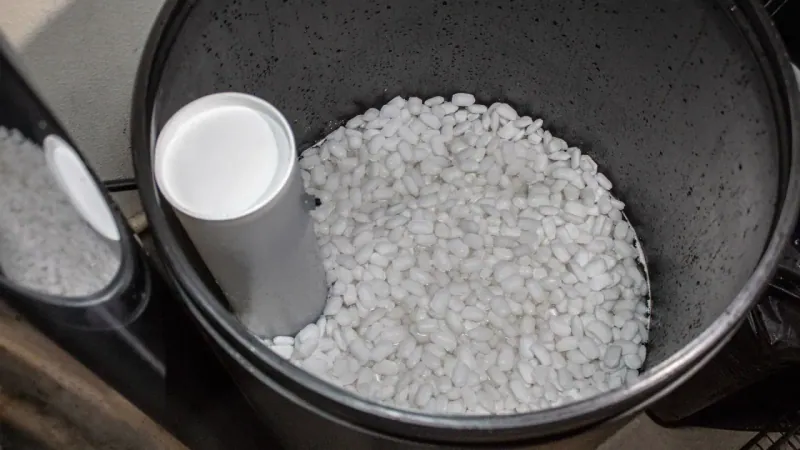
The better long-term fix is to stop the scale upstream. Pairing a tankless unit with a water softener or a salt-free conditioner keeps the exchanger clean between services, and how hard water could be harming your home explains what else those minerals are doing to your plumbing. If taste and chlorine are also on your list, whole-house filtration handles that side.
- Descale annually: more often on untreated well water, less often if the home is softened.
- Clean the inlet screen: a clogged filter mimics a failing unit and takes two minutes to rule out.
- Check the venting: on gas units, confirm the vent run is clear and properly sloped.
- Watch the flow: a gradual drop in hot water flow rate is the earliest scale symptom.
- Set it correctly: the right water heater temperature reduces scaling as well as scald risk.
Florida Permit Requirements for Tankless Installation
Installing or converting to a tankless water heater in Florida requires a permit. Section 105.1 of the Florida Building Code requires a permit to install, alter, repair, or replace any plumbing, gas, mechanical, or electrical system, and the Polk County Building Division lists water heater changeouts among the jobs that need one.
Inside Lakeland city limits the permit comes from the City of Lakeland Building Inspection Division, and unincorporated Polk County addresses permit through the Polk County Building Division. Gas venting and combustion air are inspected items on a gas conversion, which is exactly the part an unpermitted install tends to get wrong. A licensed plumbing contractor pulls the permit as part of the job.
Gas vs Electric Tankless Systems
Choose gas when the household draws hot water from several fixtures at once, and choose electric when the home has no gas service or the demand is modest. Gas units deliver a higher flow rate at temperature, which is what a four-bathroom house needs on a weekday morning. Electric units are simpler to install, need no venting, and suit smaller homes and point-of-use applications well.
The catch on electric is the electrical service. Whole-home electric tankless units draw heavily and often need dedicated circuits or a panel upgrade, and since we do not perform electrical work, that portion goes to a licensed electrician. We will tell you that during the evaluation rather than on install day.
When to Call a Plumber About Your Tankless Water Heater
Call us when any of these show up, because most of them are cheap to fix early and expensive to fix late.
- Hot water flow has dropped: usually scale in the heat exchanger, and it gets worse until it is descaled.
- Temperature swings during a shower: often a sizing or flow issue rather than a failed unit.
- An error code on the display: the unit is telling you something specific, and the code narrows it quickly.
- You cannot run two fixtures at once: the unit may be undersized for the household or starved by an undersized gas line.
- It has never been descaled and it is over a year old: book maintenance before it becomes a repair.
- A gas smell or a vent that has come loose: stop using the unit and call immediately, on our 24/7 emergency plumbing line if it is after hours.
- It is failing and out of warranty: our water heater repair team will tell you honestly whether repair or replacement is the better money.
Protect the Investment With a True Home Membership
Because a tankless unit depends on maintenance more than a tank does, an annual inspection is the difference between fifteen years and five. Our True Home Membership covers your plumbing and HVAC systems and includes a yearly tankless inspection in Plant City, Lakeland, and the nearby cities. Our post on regular plumbing maintenance covers what an annual visit actually catches.
- Annual water heater inspection
- Priority in scheduling
- No dispatch fees
- A 5% discount on water heater repairs