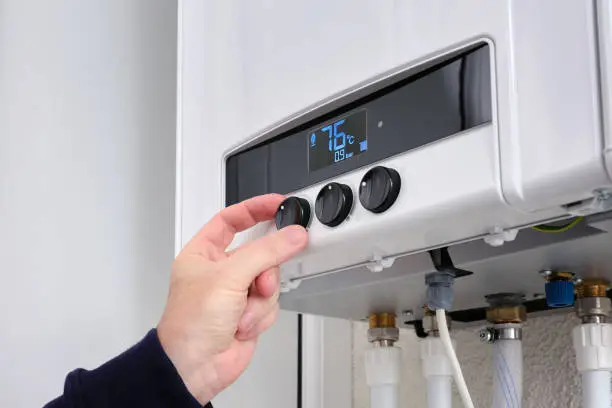
For most households the answer is 120 degrees Fahrenheit at the tap. That is the setting the U.S. Department of Energy recommends, and its home energy checklist puts it plainly: turn the water heater down to the warm setting of 120F and you will save energy and avoid scalding your hands (Department of Energy).
New tanks usually arrive from the factory set higher, often around 140F. That is not an accident either, and the reason is worth understanding before you touch the dial.
Why 140F Exists: Legionella
OSHA’s guidance for controlling Legionella in building water systems recommends storing domestic hot water at a minimum of 60C (140F) and delivering hot water at a minimum of 50C (122F) to all outlets (OSHA). Legionella bacteria grow in the lukewarm range inside a storage tank, and hot storage suppresses them.
So the two recommendations are not really in conflict. One is about what sits in the tank. The other is about what comes out of the faucet.
Why 120F Exists: Scald Risk
Hot water burns faster than most people expect. The Consumer Product Safety Commission reports that a six second exposure to 140F water causes a burn, that 130F water does it in about thirty seconds, and that even 120F water can cause a third degree burn over a five minute exposure. CPSC recommends a 120F thermostat setting to reduce or eliminate most tap water scald injuries (CPSC, Avoiding Tap Water Scalds).
That risk is not spread evenly. Small children, older adults, and anyone with reduced sensation in their hands or feet cannot pull away in six seconds. If any of those people live in the house, 120F at the tap is not a preference. It is the safe setting.
How to Get Both: A Thermostatic Mixing Valve
The way to satisfy the bacteria concern and the burn concern at once is a thermostatic mixing valve, sometimes sold as a tank booster. It lets the tank store water hot, then blends in cold water on the way out so the temperature reaching your fixtures stays near 120F.
It has a second benefit that surprises people. Because the stored water is hotter, each gallon goes further once it is blended down, so a mixing valve increases the usable hot water you get from the same tank. If your household runs out of hot water at the end of a long morning, that is often a cheaper answer than a bigger tank. If it is not, our comparison of tankless water heaters versus tank water heaters covers the alternative, and we install both tank and tankless water heaters across central Florida.
A mixing valve is a plumbing installation, not a dial adjustment. It goes on the hot outlet of the tank and it needs to be set and verified with a thermometer.
Testing Your Water Temperature
Do not trust the markings on the dial. Many of them say nothing more useful than warm and hot, and the actual output drifts as the tank ages and sediment builds up.
Let your water heater sit untouched for about an hour. Then take a cooking or candy thermometer and a cup to the faucet nearest the tank, run it on hot for a full minute, fill the cup, and read the thermometer. Heat rises inside a tank, so this reading is a good approximation of delivery temperature rather than an exact measure of what is stored.
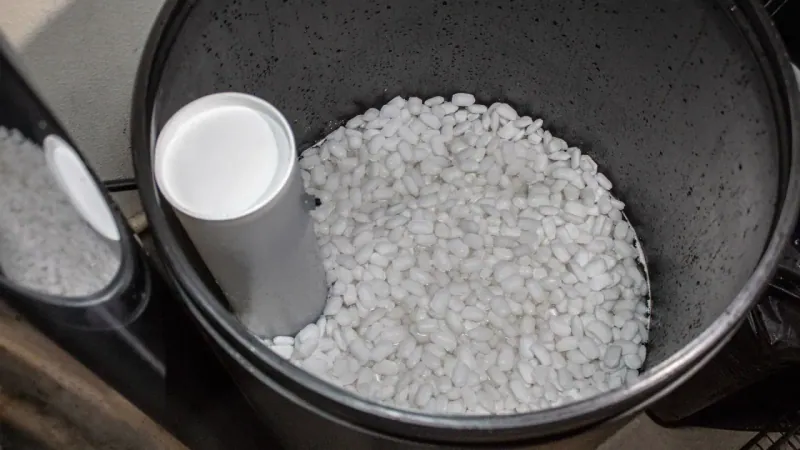
If the number comes back well under your setting, sediment or a failing element is a likely reason, and that is the same short list behind most calls for water heater repair. Hard water speeds up the scale that causes it, which is one of the ways hard water damages a home and a good argument for a whole house water softener in this part of Florida.
Adjusting Your Water Heater Temperature
Gas Water Heater
The dial sits on the front of the gas control valve. Turn it to the setting you want, then test the water at the tap an hour or two later and adjust again if you need to. The markings are approximate, so the thermometer is what settles it.
Electric Water Heater
An electric tank is a different job, because the thermostats sit behind access panels next to live wiring. Turn off the water heater breaker first and confirm the power is off before you remove anything. Then take off the panels. A double element tank has an upper and a lower panel, a single element tank only has the lower one.
Pull the insulation aside to reveal the thermostat, and set the temperature with the adjustment screw using a flathead screwdriver. On a double element tank, set both thermostats to the same temperature. Replace the insulation, close the panels, and only then restore power.
If you are not comfortable opening a panel next to live terminals, do not. Have it done for you.
Set It Once, Then Watch the Tank
The right temperature setting will not extend the life of a tank that is already failing. Rusty hot water, a rumbling noise during the heating cycle, or a puddle at the base are separate warnings, and the signs a water heater needs replacing are worth knowing before the tank picks the day for you. When it is a close call, our guide to repairing versus replacing a hot water heater walks through the tradeoff, and ignoring the early warnings gets expensive once a tank lets go inside a finished room.
A tank that fails at 2 a.m. is an emergency plumbing call. A slow seep behind a wall is quieter and often costs more, which is where leak detection pays for itself. If a replacement lands at a bad time, we offer financing on water heater replacement.
Call us for help setting or replacing your water heater.
Set the delivery temperature to 120F if there are children or older adults in the house. If you want the tank kept hot for Legionella control, add a mixing valve so the taps still deliver 120F. Either way, verify it with a thermometer rather than the dial.
We service and replace water heaters in Lakeland, Plant City, Winter Haven, and the surrounding central Florida communities. Call True Plumbers & AC at (863) 667-6364.