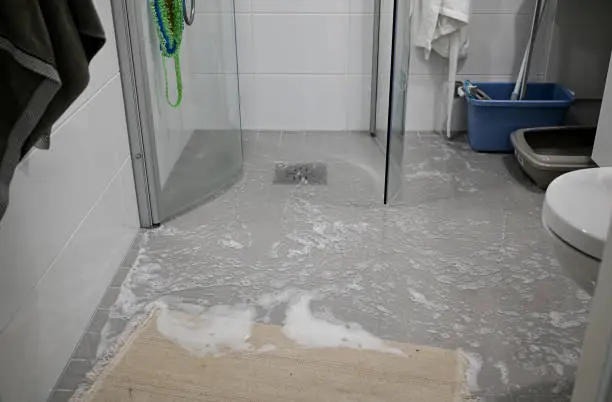
Water coming up from your shower drain means there is a blockage downstream, not in the shower itself. The shower is usually the lowest drain opening in the house, so when a clog forms in the main line or a shared branch line, wastewater from toilets, sinks, and the washing machine backs up and surfaces at the lowest exit it can find.
Nothing is wrong with the shower itself. It is the first place the problem shows up.
Key Takeaways
- The clog sits downstream of the shower, in a line the shower shares with other fixtures.
- What else backs up tells you where the clog is. Backing up when you flush the toilet points at the main sewer line. Backing up only in the shower points at that branch line.
- Stop running water immediately. Every flush and every load of laundry adds volume that has nowhere to go but up.
- Sewage in the shower is a main line problem and a contamination hazard. That one is not a DIY job.
- Gurgling without a backup usually means a vent issue, not a clog.
- Chemical drain openers make this worse. They sit on top of the blockage in a line that is already full of standing water. Here is why store bought drain cleaners are a bad idea.
Find the Clog by Reading the Symptom
Which fixtures misbehave together tells you how far down the line the blockage is. This chart is the fastest diagnosis you can do without tools.
| What you notice | Where the blockage is | What it needs |
|---|---|---|
| Water rises when you flush the toilet | Main sewer line, past the toilet connection | Main line clearing or sewer backup repair |
| Water rises when the washing machine drains | Shared branch line serving the laundry and bath | Professional drain cleaning on the branch |
| Only the shower is slow, everything else is fine | The shower trap or its own branch line | Snaking the branch, often a hair clog |
| Every drain in the house is slow at once | Main sewer line | Camera inspection then hydro jetting for stubborn drain clogs |
| Gurgling but nothing backs up | Blocked vent stack on the roof | Vent clearing, not drain clearing |
| Sewage odor and dark water in the shower | Main line or septic side | Emergency response, see below |
| Yard is soggy and drains are slow | Septic drain field, not the house lines | Drain field repair |
If the bathtub is filling too, the pattern is identical and the same chart applies. We covered it separately in what it means when water backs up into the bathtub.
What Causes the Blockage
The cause depends heavily on what your drain lines are made of, and in this part of Florida that splits along the age of the house.
Cast iron lines, common in older Lakeland and Plant City homes:
- Scale buildup: Cast iron corrodes from the inside, and the rough interior grabs everything that passes.
- Channeling: The bottom of the pipe rusts away first, leaving a trough that holds standing water and solids.
- Bellied sections: Decades of soil movement sag the pipe so waste pools instead of flowing.
- Tree roots: Roots find corroded joints and grow into the line, catching paper and grease into a mat.
PVC lines, common in newer builds:
- Grease and soap scum: Smooth pipe still narrows over time as fats cool and stick.
- Hair and soap binding together: The single most common branch line clog in any bathroom.
- Flushed items that never break down: Wipes are the usual culprit, along with the things you should never flush down your toilet.
- Improper slope from the original install: Too flat and solids settle out, too steep and water outruns the solids.
Root intrusion and bellied pipe do not clear with a snake for long. They come back on a schedule. If your main line clogs more than once a year, you have a pipe problem rather than a clog problem, and a camera inspection is what tells you which.
What to Do Right Now: Step by Step
- Stop all water use in the house. No flushing, no sinks, no dishwasher, no laundry. It keeps the backup from spreading while you work out where the clog is.
- Do not add chemicals. A drain opener poured into standing water sits there and becomes a hazard for whoever works on the line next.
- Clear what you can reach. Pull the drain cover, put on gloves, and remove hair and buildup from the trap with a barbed plastic tool.
- Try a cup plunger on the shower drain. Cover the overflow if there is one and use short firm strokes. This only helps if the clog is shallow.
- Check whether it is more than one fixture. Flush a toilet once and watch the shower. If it rises, stop testing and skip to step 7.
- Look outside for the cleanout. A capped pipe near the foundation or in the yard. If water stands in it, the blockage is in the main line.
- Call a plumber. A main line clog needs a drain machine or water jetting equipment, and standing sewage needs to be handled properly.
When the shower rise is a main line backup rather than a hair clog in one trap, a plumber in Tampa covers that job on the Hillsborough side.
If you want to try the main line yourself first, we walked through the realistic version of that job in how to clear the main drain line in your house.
Water coming up from a shower often means the main line needs drain cleaning in Lakeland, Auburndale, Bartow, or Winter Haven, not another bottle of cleaner. Call (863) 667-6364.
When to Call a Plumber
Call when any of these are true. These are the symptoms that separate a slow drain from an active sewage problem.
- Water backs up in the shower when you flush the toilet.
- Sewage or dark, foul water surfaces in the shower or tub.
- More than one fixture is backing up at the same time.
- The outside cleanout is standing full of water.
- The same drain has clogged more than twice in a year.
- Drains gurgle and you can smell sewer gas inside the house.
- Water is spreading past the shower pan onto the bathroom floor.
That last one has a second problem attached. Water on a bathroom floor gets under tile and into the subfloor, and the damage often outlasts the clog. If you suspect water has been getting somewhere it should not, leak detection finds it without opening walls.
When it is actively spilling into the house, that is emergency plumbing, and you can schedule service online or call and we will move.
Keeping It From Happening Again
Most repeat backups are the same clog re-forming in the same spot. The fixes are boring and they work.
- Catch hair before it enters the drain. A cheap screen in the shower prevents the clog we get called about most. If yours is already building up, here is what actually dissolves hair in a drain.
- Flush waste and toilet paper only. Nothing labeled flushable is flushable.
- Keep grease out of every drain, kitchen included, because it ends up in the same main line.
- Get the main line inspected on a schedule if your home has cast iron or mature trees near the sewer path. A camera run every year or two catches roots and bellies while they are still cheap.
- Know the warning signs early. We listed them in 5 warning signs of a sewer line problem and in these tips to keep your drains from getting clogged.
Recurring main line service is one of the things our True Home Membership is built around, and if a camera inspection turns up a pipe that needs replacing rather than clearing, financing keeps that from becoming an emergency decision.
Frequently Asked Questions
Q: How do I stop water from coming from my shower drain?
Stop running water anywhere in the house first, including toilets and the washing machine. Every gallon you send down has to go somewhere, and the shower is where it comes back. Pull the drain cover and clear visible hair. If the water still rises, the blockage is past the fixture and needs a drain machine.
Q: Why is water coming back up my shower drain?
Because the shower is usually the lowest drain opening in the house. When a clog forms downstream, wastewater from higher fixtures backs up and takes the first exit it can find. That exit is your shower. The clog itself is almost never in the shower.
Q: Why is poop water coming out of my shower drain?
Sewage in the shower means the blockage is in the main sewer line, past the point where the toilet drain joins it. Toilet waste has nowhere to go, so it surfaces at the lowest opening. Stop using water and call a plumber. This is a contamination hazard, not a cleaning job.
Q: Is it okay to pour boiling water down a shower drain?
Not into a drain that is already backed up. Boiling water can soften PVC joints and crack a porcelain fixture, and if the line is blocked the water just sits there. Hot tap water is fine for routine maintenance on a drain that still flows.
Q: My shower drain is backing up but there is no clog I can find. What now?
If you cleared the trap and water still rises, the blockage is further down the line where you cannot reach it. It can also be a blocked vent stack, which starves the drain of air and causes gurgling and slow backups. Both need a plumber with a camera.
Q: Why does water come up in the shower when I run the washing machine?
The washing machine dumps a large volume fast, and it shares a drain line with your bathroom. If that shared line is partly blocked, the surge has nowhere to go and surfaces at the shower. It points to a branch line or main line clog, not a washing machine problem.
Q: Water comes up in the shower when I flush the toilet. What does that mean?
That combination almost always means a main sewer line clog. The toilet and shower share the main line, and the blockage sits past the point where they join. Do not keep flushing to test it. Each flush adds more wastewater to the shower.
Q: Why does my toilet overflow when the shower backs up?
Both fixtures are fighting for the same blocked main line. Whichever one you use fills up first. If the toilet is the one spilling, here is what to do when a toilet overflows, and the underlying fix is the same main line clearing either way.
Talk to a Plumber Who Has Seen This Before
True Plumbers & AC has been clearing main lines in Central Florida since 2009. We run a camera before we quote a repair, so you find out whether you have a clog or a failing pipe before you pay for either.
Our Lakeland plumbers and Plant City plumbing team handle shower backups, main line clogs, and sewer repairs across the area, including Winter Haven.
Call (863) 667-6364.
License CFC1428965 (plumbing) and CRC1335717 (HVAC) | Insured | Family owned since 2009
Our services
Water coming up from the shower drain
The shower is the lowest opening, not the clog. If water rises when you flush, the blockage sits in the main line.
- Drain Cleaning A drain machine reaches the branch or main. A plunger in the shower does not. See this service
- Sewer Backup Repair Sewage in the shower is a main-line backup. Stop running water and call. See this service
- 24/7 Emergency Plumbing After hours or a house that will not drain at all. Dispatcher is on 24/7. See this service